
Crater Metropolitan Authority
When Integrity Sinks Beneath our Potholes

Bangalore’s corporation authority was recently rechristened “Greater Bangalore Authority.” More appropriately: Crater Bangalore Authority. If potholes were lunar craters, our roads would make the Apollo missions look like joy rides. Each crater here tells its own story - of inflated contracts, vanished funds, and an accountability system lost in orbit.
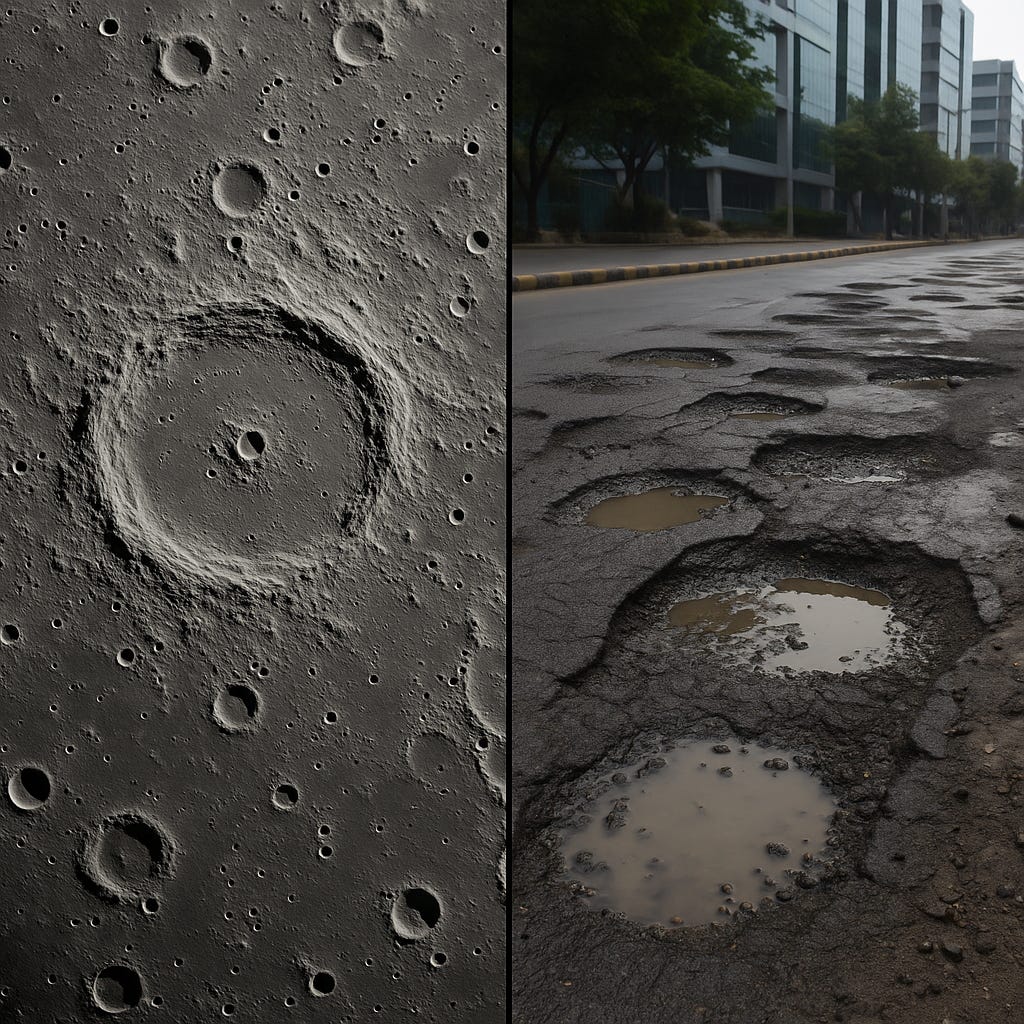
These are not mere blemishes that stand out, but part of a vast web of corruption in India that stretches across every walk of life: from a filthy footpath to the grandest infrastructure project.
A Fictitious Yet Possible Day in India
Let’s imagine a particular Mr. Rao’s routine one fine day - though the truth is, you don’t really need imagination. These things really happen.
Rao set out in his car in the morning to complete a few essential chores. A policeman waved him down, asking for his car’s pollution certificate. As he fumbled for the papers, a mini truck spewing black smoke zipped past; the driver, having greased palms earlier, sailing through unpunished.
Ahead of Rao in the “queue” at the police booth:
• a truck with metallic rods jutting out dangerously
• a triple-ridden motorbike, helmets nowhere in sight
• a drunk young man wobbling on his bike
• and a boy hardly twelve, riding a scooter
None of them were booked. They were simply waiting their turn to “contribute”.
Paying for What Should Be Free
From there, Mr. Rao went to the municipality office to register his new house. A hefty under-the-table fee later, the file moved. His subsequent visits: to apply for electricity and water connections - elicited the same treatment.
Tired and significantly poorer, Rao stopped at his friend John’s new pub-cum-microbrewery for a drink.
John laughed bitterly: “The pub license costed me ₹3 lakhs (USD 3,500). But the bribe to actually get one? ₹3 crores (USD 350,000).”
Post lunch, Rao visited the local GST office to contest a wrongly computed penalty. A small “facilitation” payment to the clerk, and the error disappeared.
Multiply this phenomenon across any government establishment you can think of - health centres, education departments, ration shops, municipalities: and you have a comprehensive misery list of the common man in India, thanks to a deeply entrenched malaise.
More Brutal for the Poor
If this is the daily reality of an ordinary middle class citizen - frustrating and unfair - for the poor, it is much worse. For them, every bribe is a struggle for survival.
A bribe at a government hospital can mean the difference between getting a bed or being left in the corridor. A missing ration card means a family goes hungry. Corruption isn’t just an inconvenience - it is a death sentence for the downtrodden.
Silicon Valley of India with Lunar Roads
Irony plays its part. I live on a road flanked by the glass towers of global IT majors on both sides, the so-called Silicon Valley of India. The roads outside are either potholes or puddles, depending on the season. Legislators don’t care - the local residents are mostly migrants, not their vote bank.
When ministers visit, residents are warned by political goons not to voice grievances. “Everything is fine, don’t embarrass us,” we’re told.
And yet, nationalists who root for the Mahaan-ness of Mera Bharat mock those who seek a better life abroad - pretending to be oblivious to the ills that plague the country. Migration rates of the educated are touching new records each year, despite immigration obstacles. Visa difficulties and second-class treatment overseas seem like a honeymoon compared to the daily horrors one faces in one’s own land.
A Helpless Leader
The Prime Minister keeps proclaiming missions and grand designs to root out corruption. Yet, on the ground, bribes keep attaining gargantuan proportions.
Projects still exist primarily to fill politicians’ pockets, with inflated contracts and ghost work. Governments, regardless of party, prioritise big-ticket projects - a tunnel road here, a double-decker flyover there - over completing functional public transport, for obvious reasons. A flyover sometimes takes a decade to finish, thanks to bureaucratic hurdles and loose land laws.
Many of our politicians, who started from humble or even poor backgrounds, have somehow become billionaires during their time in office. No serious questions are asked. No audits are done. No accountability exists.
How different, really, are we from anarchic African dictatorships where leaders loot the state while the public struggles for basics? The uniforms and accents may differ, but the story sounds eerily the same.
India ranks 96th out of 180 countries in Transparency International’s 2024 Corruption Perceptions Index, with a score of 38 out of 100 — clear evidence that corruption is far from abating.
The Convenient Excuse of Population
Whenever corruption or inefficiency is discussed in India, the fallback excuse is almost always the same: “We are a country of 1.4 billion; what can we do?” Population becomes the all-purpose justification for failures of planning, governance, and integrity. Other nations, with large populations and comparable diversity, have built efficient systems because accountability was non-negotiable. In India, scale is used not as a challenge to overcome but as a shield to hide behind. We accept potholes, broken public services, and endless queues as natural byproducts of size, rather than symptoms of systemic neglect. Our numbers are real, but so is our complacency.
Why Corruption Persists
The reasons are well known:
• Excessive discretion in officials’ hands
• Weak oversight and vanishing complaints
• Opaque processes
• Political incentives favouring vote banks over good governance
• Bureaucratic high-handedness and intimidation
Corruption is not an anomaly; it’s a parallel economy sustaining an irreparable status quo.
How Countries Fought Back
Other nations have shown that change is possible.
Singapore created an independent bureau with full authority to prosecute; they paid public servants well and refused to spare even top politicians.
Hong Kong’s ICAC combined investigation with prevention and education to change the culture.
Georgia digitised services and fired corrupt officials after its Rose Revolution.
Estonia moved almost all government services online, removing face-to-face interaction entirely.
These models show that corruption can be reduced when systems are redesigned, not merely when leaders make token announcements.
India too has made small gains: Direct Benefit Transfer for LPG cut subsidy leakages. The Government e-Marketplace increased transparency in procurement. But these are rare islands in a sea still mired in manual processes and discretionary power.
What India Needs to Do
Expand faceless, online, and time-bound services to cut opportunities for bribes
Strengthen independent agencies free from political meddling
Simplify complex rules and eliminate unnecessary licenses
Publish all fees, contracts, and procurement details publicly
Protect whistle-blowers and journalists who expose corruption
Ensure visible, high-profile convictions to shift cultural norms
Reform political financing to reduce dependency on illicit funds
Unlike authoritarian regimes that bulldoze corruption through fear, India’s democracy demands transparency and accountability within institutions. Countries like Estonia have proven that it’s possible without sacrificing freedoms.
The truth is uncomfortable: we, the public, are part of the problem. Paying bribes keeps the wheels turning. To break the cycle, we must redesign how citizens and the state interact every day.
A Closing Thought
This is the story of a common man in India — frustrated, poorer, and yes, often complicit. But democracy gives us tools: media, citizen audits, and elections.
If Estonia can build an incorruptible system from Soviet rubble, if Georgia can reset its police, and if Singapore can transform from a bribery-plagued port to a clean state — then India too can change.
Until then, our cities will continue to resemble the moon. Craters included.
References and Further Reading
Corrupt Practices Investigation Bureau (Singapore)
Independent Commission Against Corruption – Hong Kong
World Bank – e-Governance in Estonia
OECD – Anti-Corruption Reforms in Georgia (2016 Report)
Transparency International – India Country Overview
World Bank – Digital Government-to-Person (G2P) Payments
Transparency International – Integrity Pacts in Public Procurement
OECD – Public Procurement and Corruption: High-Risk Areas
Coverage on infrastructure woes: The Hindu, Deccan Herald, Indian Express
I agree with the author about the ravages of corruption on the economy and daily life.
The tradespeople are often from the low socio-economic classes. An average electrician, plumber, or bricklayer earns much more than an engineer in the West. The dignity of labour is lacking in India, often associated with the labour class being perceived as a lower social class.
No matter how much bureaucratic corruption is eradicated in India, the problem of potholes on roads will persist until tradespeople are accorded the dignity and extensive training they deserve.
Brilliant piece, Sunil. A powerful reminder that until accountability becomes non-negotiable, our cities will keep resembling the moon craters.