
The Chopsticks Conundrum
Floundering in a world that never needed spoons

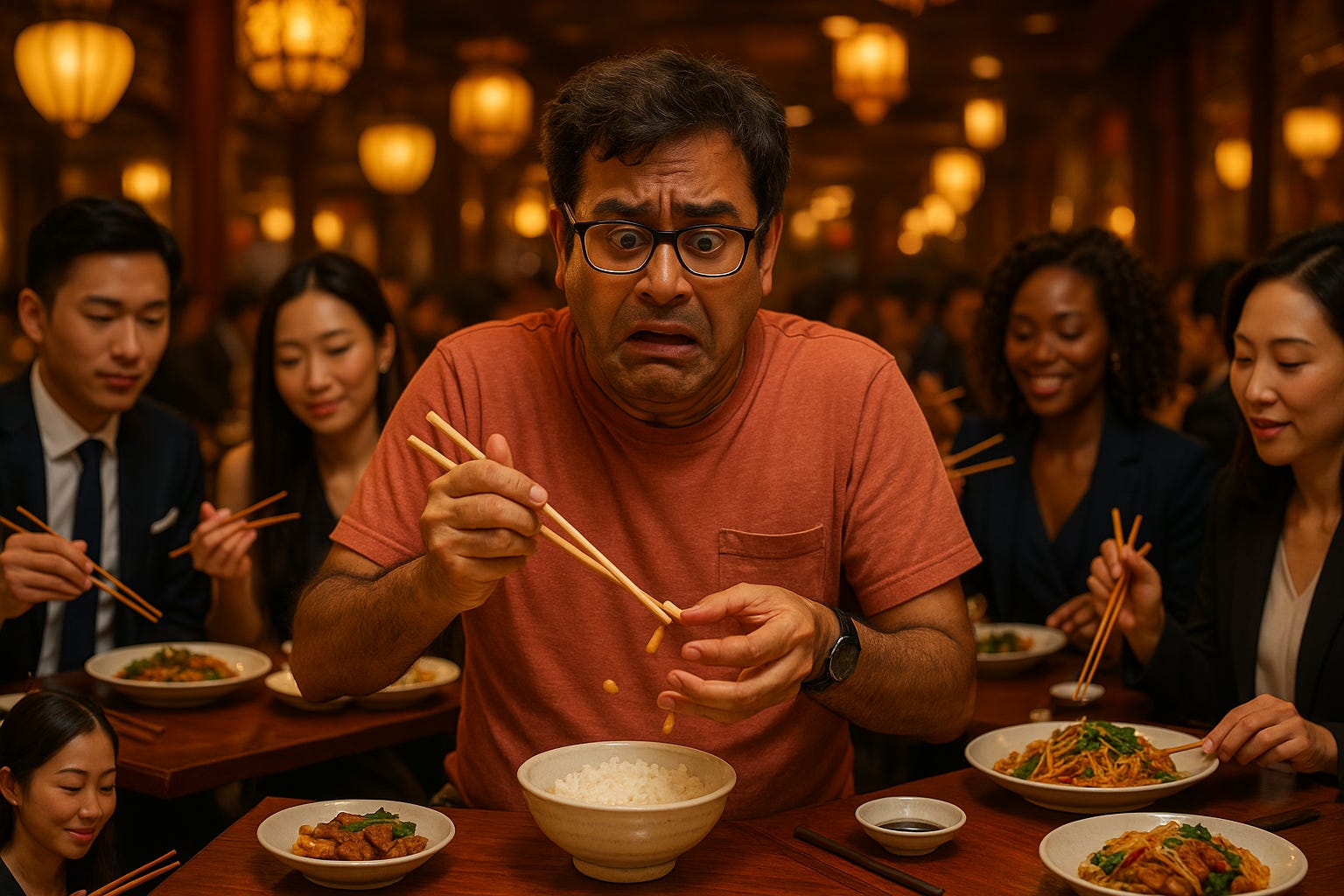
We found ourselves in a bustling Chinatown restaurant a few years ago - the kind where, crammed tables are filled with the loud buzz of conversations and laughter as steaming, sizzling, aromatic dishes zip by; and where customers patiently wait at the counter, eyes keenly searching for the next vacant table
Our table for two stood out for the wrong reasons. We were the only ones who couldn’t wield chopsticks. All around us, elegantly dexterous diners, guided their twin wands with wizardly ease - flipping, lifting, twirling, without missing a morsel. Meanwhile, we waited sheepishly for our spoons like helpless infants waiting for bibs.
I did try though. Over the years, I’ve made several sincere attempts to master the art of conquering my chopsticks: inspired by travel shows, friends, and the occasional travel souvenir. Each time I began with great enthusiasm – only to lose momentum somewhere between noodles and momos.
The Taizhou Tragedy
But my most embarrassing encounter came in Taizhou, a small (by Chinese standards) yet bustling industrial city in China. My hosts took me to a traditional restaurant - carved furniture, red lanterns, and the welcoming aroma of the magical five-spice blend. I sat down, famished and ready to dig, when I realised that only chopsticks were laid on the table - no spoons or forks. Not a single one. I sat, hands down, helpless and blank, inviting even more stares in a town where being brown is rarer than being from Mars
My hosts, ever gracious, looked apologetic and left no “stick” unturned to salvage the situation. ‘Ah, no spoon! No spoon here.’ They despatched a young waiter on an emergency cutlery rescue mission. Half an hour later, he returned triumphantly holding a lone ceramic soup spoon - procured gallantly after scouring the entire neighbourhood. A big relief…though I had to find various ways with it to cut fish and chicken and to scoop dry noodles-lowering my head towards my bowl to avoid spillage, at the risk of burning my nose.
That episode got me wondering:
How did chopsticks become the default dining accessory across so much of Asia - especially when innovation and metallurgy provided simpler options like spoons, knives, and forks?
In India, our ancestors used leaves and hands as the most efficient eating accessories. No anxiety, no fumbling, no confusion. We ate instinctively.
So, how did the East alone end up with these sleek little sticks?
How the Sticks Ruled Asia
Chopsticks first appeared over 3,000 years ago during the Shang dynasty. Food was mostly boiled then, and people used sticks to pick hot morsels from communal pots. Confucius himself recommended them for their gentleness: knives, he argued, were tools of war, unfit for a peaceful meal.
His philosophy discouraged the use of sharp knives at the dining table as they were associated with violence and conflict. As food preparation techniques evolved, most foods were cooked, soft, and cut into bite-sized pieces before they reached the table, reducing the need for knives. This made chopsticks, which are better suited for picking up small pieces, more practical and safer. The use of chopsticks also suited the use of delicate ceramic dishes, which could be damaged by metallic cutlery.
Japan adopted chopsticks later, introducing Hashi, shorter and more tapered, for their delicate cuisine. Korea took another route – metal chopsticks. Vietnam followed suit with longer ones, perfect for their noodle soups.
The Rice Riddle
Now here’s the paradox: how do you eat rice - a food that practically begs to be scooped - with two slim sticks? As an Indian used to scooping rice and curry with a graceful cupping of the fingers, this has always seemed like an anomaly.
The secret lies in texture, as I discovered. East Asian rice varieties are short-grained and sticky. The grains are like close friends who flock together, making it possible to lift small clumps without disaster. Contrast that with our basmati — sleek, fragrant, independent, totally unsuited to chopstick dynamics.
So perhaps like evolution, dining tools adapted to local species. Sticky rice gave birth to chopsticks. Dry rice beckoned our fingers. Straight and simple.
Still Learning
So here I am, years later, still struggling through my relationship with these vestigial appendages. I’ve improved — slightly. I can now manage noodles with minor collateral damage on my shirt, and the odd sushi easier still. But rice? No way.
Well, who knows? One day I might finally emerge triumphant and master the art. Until then, I’ll raise my spoon — or my awkwardly held chopsticks - in salute to a world that finds joy in the simplest acts: eating, sharing, and conversing - one slippery momo at a time.
Another relatable post, Sunil! We had a front-row seat to this struggle at a Thai place in Hong Kong recently. My lack of chopstick skills is so legendary that we actually packed our own disposable forks and spoons. It wasn't pretty, but it was effective!
Enjoyed it a lot imagining myself in this scenario😄