
The Curry Code
Why Indians are naturally wired to dominate the software world

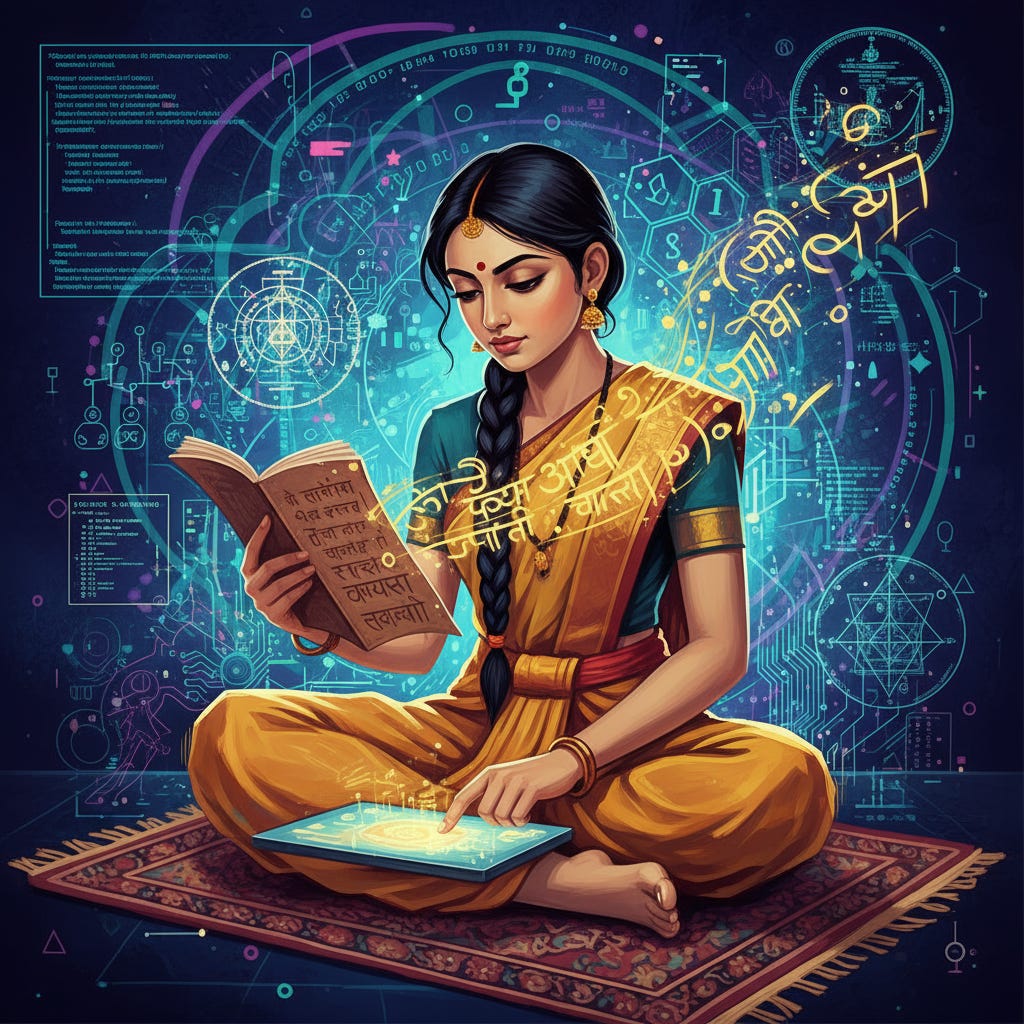
During a business meeting about 25 years ago, an Israeli colleague leaned in with a knowing smile and asked me a question he clearly already had an answer to: “Do you know why Indians are so good at software? Uncertain of where he was taking this since we did not belong to that industry, I shook my head.
With an enlightened smile, he said, ‘Sanskrit.’ The Indian IT boom had just taken off at that time - around the late 1990s to early 2000s -which coincided with Infosys, TCS, Wipro etc. rising globally.
He then went on to explain, with great conviction, that Indians had a sort of innate aptitude for logic and languages because of the structure and accuracy of Sanskrit, and most Indian languages that are derived from it. It seemed pretty clear to him, without a hint of doubt, that a brain capable of learning ancient grammar could also learn computer code.
Looking Back
Now that I think about it, my friend’s words feel almost prophetic. The dominance of Indian IT professionals has reached gargantuan proportions. So much so that the American President himself now looks for ways to axe their ascendance in the US tech industry.
Indians appear to be writing the digital future everywhere you look, from boardrooms in California to offices in Bangalore. And so, I thought maybe it’s time to dig a little deeper and explore the obvious, and not-so-obvious, reasons behind this phenomenon. Since I don’t work in the software sector myself, I may have the advantage (or the ignorance) of viewing it from a different angle – though, admittedly, India’s IT strength is more commonly attributed to factors such as English proficiency, educational infrastructure, outsourcing demand, and global economic shifts in the 1990s.
Sanskrit as Structure
Let’s start with Sanskrit. My Israeli friend probably wasn’t totally off the mark. Sanskrit is much more structured than other languages; I experienced it myself in school up to the 9th standard. If you memorise the different sequences, you will emerge on top. Every noun and verb fall into neat patterns and predictable combinations. Take the word Rama: it becomes Rāmaḥ (subject), Rāmam (object), Rāmasya (possessive), or Hey Rāma (vocative) depending on usage. Multiply that across every noun and verb, and you get a language that is almost algorithmic in its precision — a sort of template for logic and order.
Panini, the 4th century grammarian, inadvertently wrote the first formal “compiler” for a language. A friend of mine, a former tech head honcho who is currently rigorously learning the Vedas, tells me that “coding, in many ways, is just a modern version of chanting slokas: exact sequences, strict grammar, and a beauty that reveals itself only when everything is perfectly in place.”
Multilingual Advantage
And then there’s the Indian habit of switching between three or four languages daily — the mother tongue at home, Hindi or a regional language outside, English in school or office, and Hinglish or a mixed diction in between. Our brains learn to swap with ease, and thus coding, I guess, is nothing but learning new “languages.” For an Indian engineer, learning Python after C++ is no more unusual than switching from Hindi to English to Malayalam in the middle of a sentence.
Speed of Thought
Indians generally speak fast. Entire arguments or debates about cricket or politics or films occur at double speed. Is that chatter or mental agility? When dealing with deadlines, problems, and “stack overflows” (happens when a computer program gets stuck using itself too many times and running out of memory — like talking in circles until your brain crashes), during coding, quickness of thought is critical. Indians have been doing this since childhood, simply trying to get a word in at different places in different ways and at different times.
Order in Chaos
We have a natural way of finding order in chaos. Traffic in India is chaos redefined, but everyone makes it to their destination. The same instinct applies to debugging messy legacy code or making sense of conflicting project needs. Where others panic, Indians thrive.
Survival Instinct
Darwin’s theory is put into practice in everyday living in India. Growing up in India makes attending a coding bootcamp like child’s play. Competition starts from the time you are born - finding a hospital bed, competing for school admissions, finding a seat in the bus, queuing up for food in the canteen, surviving brutal entrance exams, overcrowded trains, bustling markets, power and water shortage…the list goes on. Competition is all-pervasive. If you can handle all these, fixing an outage at midnight would feel almost relaxing. Survival sharpens logic, persistence, and resilience — all traits of a great programmer.
Jugaad Spirit
Jugaad — our much-loved word for creative problem-solving, even where solutions seem non-existent. Why buy new hardware when you can patch it with a wire and tape? Why write 100 lines of code when a few will do? That hacker spirit — frugal, clever, and mischievous — is the DNA of coding itself.
So perhaps my Israeli colleague was right. Maybe it’s not only about Sanskrit. But also, the languages we juggle, the chaos we navigate, the speed with which we think, the constant competition that toughens us.
Indians didn’t set out to dominate the software world — we were just built for it and happened to be there. Coding, after all, is nothing but life in India, written in a different script.
Factual Notes & References
· https://www.indiafacts.org.in/preserve-sanskrit-preserve-ancient-indian-knowledge-systems/
· https://www.indiafacts.org.in/preserve-sanskrit-preserve-ancient-indian-knowledge-systems/
· https://www.financialexpress.com/india-news/coding-can-be-done-in-sanskrit-it-is-most-computer-friendly-language-claims-delhi-cm-rekha-gupta/3832160/
· Brookings – The Rise of India’s IT Industry: https://www.brookings.edu/articles/the-rise-of-indias-it-industry/
· The Economist – Software Nation: https://www.economist.com/asia/2013/10/12/software-nation
Well-researched post. The post brings together the story of Indians, software coding, Sanskrit, and competition, which are related through a blend of cultural heritage, intellectual rigour, and modern innovation.
Loved the post. It's so true how our everyday life here prepares us for all this.